












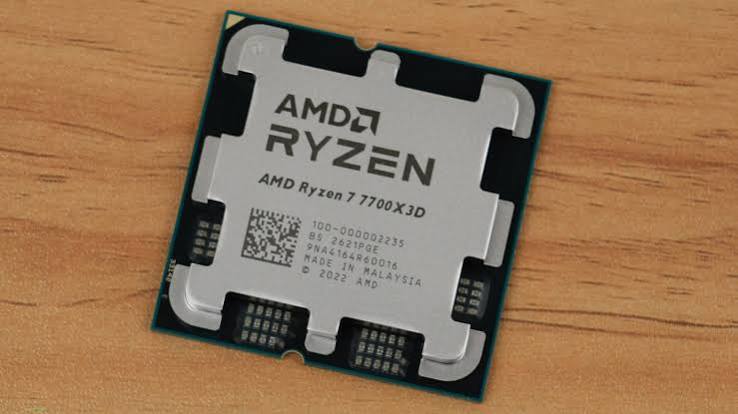
AMD released the Ryzen 7 7700X3D on July 16, a new 3D V-Cache gaming chip priced at $329. Built on the older Zen 4 architecture, the processor is meant to give budget-minded gamers a cheaper way onto the AM5 platform, but early reviews are split on whether it actually makes sense next to AMD's own lineup.
What AMD Announced
The Ryzen 7 7700X3D is an 8-core, 16-thread desktop CPU running at a 4.0 GHz base clock with boosts up to 4.5 GHz. It carries a 120W TDP and 104MB of total cache, including 96MB of L3 cache thanks to AMD's stacked 3D V-Cache technology. The chip is compatible with existing AM5 motherboards, meaning current Ryzen 7000 and 9000 series owners can drop it in without a platform change. At launch, the 7700X3D was sold exclusively through Newegg in the US and Canada for the third quarter before wider retail availability opens up.
Pricing places the chip just above the Ryzen 7 7600X3D's $299 MSRP and well below the Ryzen 7 9850X3D, which runs closer to $490. AMD is positioning it as an entry point into 3D V-Cache gaming performance for people upgrading an older AM5 build or building fresh on a tighter budget.
How It Actually Performs
According to AMD's own internal testing across more than thirty modern titles at 1080p, the 7700X3D delivers roughly four percent higher average gaming performance than the standard, non-X3D Ryzen 7 7700X, despite running at noticeably lower clock speeds. Independent reviewers largely confirmed that the extra cache does what 3D V-Cache chips typically do best: smoothing out frame times and boosting performance in cache-sensitive games, even without class-leading clock speeds. Efficiency numbers also came in strong, with several outlets noting low power draw and cooler operating temperatures compared to non-X3D parts in the same price range.
Why Reviewers Are Skeptical
The performance is solid, but the pricing has drawn criticism. At $329, the 7700X3D sits awkwardly between two siblings that make it harder to recommend. The Ryzen 7 7800X3D, a faster and more established chip, often sells for only marginally more than the 7700X3D's launch price, undercutting the case for choosing the newer, slower part. On the other end, the cheaper Ryzen 7 7600X3D closes much of the performance gap for significantly less money, further squeezing the 7700X3D's position in the lineup. Some outlets described the chip as a "good CPU, terrible launch," arguing the hardware itself is fine but AMD's pricing strategy undermines the value proposition it's supposed to offer.
Conclusion
The Ryzen 7 7700X3D proves 3D V-Cache still delivers a real gaming boost even on aging Zen 4 silicon, and its efficiency and AM5 compatibility make it an easy drop-in upgrade for existing builds. Whether it's worth buying largely depends on where it lands relative to the 7800X3D and 7600X3D once wider retail pricing settles in over the coming weeks.
FAQ
When did the AMD Ryzen 7 7700X3D launch?
The chip launched on July 16, 2026, with an SEP price of $329.
What architecture does the Ryzen 7 7700X3D use?
It's built on AMD's older Zen 4 architecture, the same generation as the original Ryzen 7000 series, rather than the newer Zen 5.
Is the Ryzen 7 7700X3D compatible with existing motherboards?
Yes. It uses the AM5 socket, so it works in existing Ryzen 7000 and 9000 series motherboards with a BIOS update if needed.
How does it compare to the Ryzen 7 7800X3D?
The 7800X3D is generally faster and, depending on retail pricing, can cost only slightly more, which is the main criticism reviewers have raised about the 7700X3D's value.
Where can I buy the Ryzen 7 7700X3D?
At launch, it was sold exclusively through Newegg in the US and Canada for the third quarter, with broader retail availability expected afterward. It's now also available on Amazon (paid link) at its $329 launch price.
Is the Ryzen 7 7700X3D a good gaming CPU?
Reviewers agree the chip performs well for gaming thanks to its 3D V-Cache, with roughly four percent higher average gaming performance than the standard 7700X, but its pricing relative to AMD's own lineup is the main point of contention.